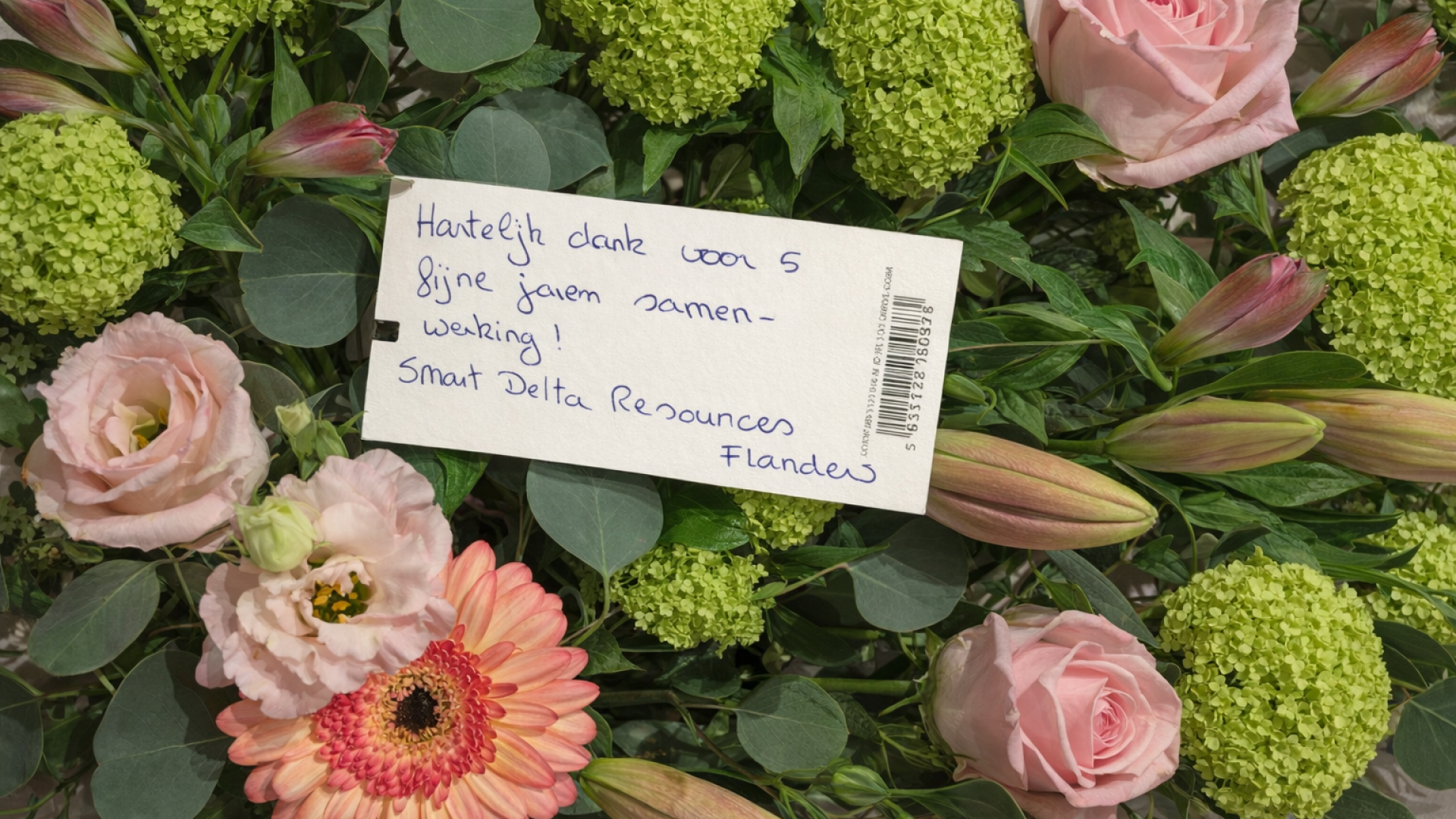
From individual challenges to systems thinking: a look back after five years of leadership at SDR Flanders

In recent years, Smart Delta Resources Flanders has grown into a key collaborative platform for industrial players in the Scheldt Delta region. In this retrospective, Manfred Van Vlierberghe, former chair, and Carl De Maré, former director, share their insights on why SDR Flanders was needed, how collaboration in the region has changed, and what they believe must absolutely be preserved for the future.
1. Five years ago, you decided to join SDR Flanders. What challenges did you identify at the time within Flemish industry and in this cross-border port region?
Manfred Van Vlierberghe:
“At the very first board meeting, an inventory was drawn up of CO₂ emissions per port cluster in the Benelux, and North Sea Port emerged as the second-largest emitter with 22 million tonnes of CO₂ (after Rotterdam). These emissions were much higher than those of Antwerp or Amsterdam. We saw CO₂ as a challenge, but also as a strategic opportunity, provided that companies acted together.”
“At that time, there were already collaborations and initiatives in the region. But what we lacked was a place where Flemish industrial players, across sectors, could engage structurally with one another and with the government, the port, network operators and knowledge partners. In other words: there was a need for a Flemish platform that would enable collaboration not by chance, but consistently and purposefully.”
Carl De Maré:
“What you see here is a strong mix of industries: steel, chemicals, logistics, automotive, agriculture, and so on. Many companies were grappling with the same challenges regarding CO₂ and energy, but were not collaborating enough on these issues. It is precisely this combination of diversity and concentration that makes the potential in this region exceptionally great.”
Manfred Van Vlierberghe:
“That is why, together with Carl De Maré (former CTO of ArcelorMittal), Daan Schalck and Astrid Vliebergh (the then CEO and Head of Commercial Affairs at North Sea Port), and in consultation with SDR NL, we took the step towards SDR Flanders.”
Carl De Maré:
“And the great thing is: five years on, all the companies we started out with are still on board, whilst many other companies have joined in the meantime. That shows we’ve built something that works.”
2. SDR Flanders grew during a period of successive crises. How have those circumstances changed the way you work, and how do you manage, at the same time, to keep the long-term transition towards sustainability on track within SDR Flanders?
Manfred Van Vlierberghe:
“Crises force you to move forward. The pandemic, the war in Ukraine, soaring energy prices and geopolitical tensions forced us to think outside the box; business as usual was no longer an option.”
Carl De Maré:
“This led to a fundamental shift in the way we worked: from consultation to systems thinking. Companies engaged in open dialogue and gained a better understanding of each other’s challenges and opportunities, even across sectoral boundaries. We brought all these insights together in the SDR Vision Statement in 2022.”
For SDR Flanders, bringing facts together and putting them into context has always been crucial in this regard. It turned out, for instance, that reducing 22 million tonnes of CO₂ emissions to zero through electrification alone would require almost twice as much electricity as is currently consumed in Belgium and the Netherlands combined, and that’s just for the SDR region!
“That is precisely why we are exploring every possible solution and why our task forces are working on CCUS, B2B heat, electrification and circularity.”
Manfred Van Vlierberghe:
“At the same time, sustainability was often under pressure. Companies had to focus first and foremost on survival. It is precisely at such times that it is crucial to keep an eye on the long term, without ignoring reality. On the board, we therefore frequently hold strategic discussions in which we also examine the policies being developed at European level and how we, as a region and as an industry, should respond to them.
Technology and innovation play a crucial role in this, not as an end in themselves but as a means to an end. Companies ask questions, experts from Ghent University and CAPTURE provide knowledge and solutions, and SDR brings these parties together. That is where genuine collaborations take shape.
It all comes down to trust. When companies know they are not alone, they have the confidence to keep investing in the future, even in difficult times.”
3. Where do you see the greatest efforts being made by members today? When have you yourselves felt most strongly that cooperation in this region adds value? And what is the next, more challenging step?
Carl De Maré:
“Today, we’re seeing huge efforts being made in the areas of electrification, district heating networks, water management and CO₂ solutions. What has struck me most personally is how companies that used to barely speak to one another are now working together to devise shared solutions.
CO₂ infrastructure is a good example of this. It’s simply too big and too complex for a single company. The CO₂ backbone connecting North Sea Port with Zeebrugge is an area where we at SDR have played a significant role. By bringing companies together, you can create speed, scale and support. That is the added value of SDR. We are also looking further afield, across national borders, together with SDR NL, as the section below the Westerschelde is located close to Flanders.”
Manfred Van Vlierberghe:
“The next step will be more challenging: moving from planning and studies to effective implementation. That will require investment, planning permission and clear conditions. But without the cooperation that exists today, that step would not even be possible.”
4. At the last board meeting, SDR Flanders handed over the reins: Frederik Van de Velde (CEO of ArcelorMittal Belgium) is taking over as chair, and Bob Van Schoor (former Head of Industrial Energy Solutions at ENGIE) is succeeding Carl De Maré as director. What specific advice are you giving your successors?
Manfred Van Vlierberghe:
"What absolutely must be preserved is the culture of trust. SDR Flanders is a neutral platform where companies feel confident sharing their real challenges, not just their successes, but their problems too. That trust cannot be taken for granted. It is the result of years of consistent effort, and it must be nurtured.
I would also emphasise the importance of ambassadorship: listening to members, interpreting their feedback correctly and ensuring support. SDR Flanders must be visible when shared insights or bottlenecks need to be clarified, but always without taking sides with individual companies or projects."
Carl De Maré:
“That is why we remain committed to fact-based positions and knowledge development. All solutions deserve consideration, but without facts – and without placing them correctly in context – it is difficult for a business or government to understand what the ‘no-regret’ next step actually is. That is precisely where we want to continue to invest.”
5. What role should SDR Flanders play for this region and our businesses over the next five years?
Manfred Van Vlierberghe:
“The core role remains the same: helping businesses and the government to think and act together on issues that no single company can resolve on its own. This requires SDR to play a connecting and facilitating role.”
Carl De Maré:
“The coming years will be all about implementation: CO₂ infrastructure, energy, heat exchange and water management. This requires close collaboration with partners in Flanders and the Netherlands. To further strengthen and embed this collaboration, we are in discussions with VLAIO regarding structural support for our initiatives.”
Manfred Van Vlierberghe:
“At the same time, neutrality remains crucial. The SDR must be visible where it makes a difference and provide insights backed by facts and data, without losing the trust of its members. If it succeeds in doing so, this region can continue to serve as a testing ground for industrial cooperation, even in difficult times.”